Natixis: Metal markets seen weakened in Q2 on slow US economy, European crisis
After a weak fourth quarter in 2011, metal markets bounced in the first quarter of this year, boosted by the strength of US economic data, the success of the ECB’s long-term repo operations and optimism over a recovery in Chinese growth, Natixis said in a quarterly metals report. Heading into the second quarter, this optimism is beginning to wear thin.
ALUMINUM. The global aluminum market has been in a substantial surplus for three of the last four years, caused primarily by the rapid expansion of Chinese production capacity. In 2012, although the potential for further oversupply remains a significant risk, the bank would expect the actual surplus to diminish significantly. With a large proportion of global aluminum production unprofitable at current prices, it makes sense for producers to close (at least temporarily) their higher cost production facilities. This is already depressing output in Europe and Latin America.
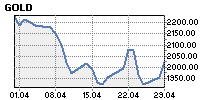
After pushing up above $2,300/tonne at the end of February, aluminum prices have since dropped back towards $2,000/tonne, as the prospects for Chinese growth have disappointed, alongside deterioration in US economic data and a steadily worsening outlook for Europe. Cutbacks in aluminum capacity among western producers pale into insignificance compared to the size of the potential change in output that could take place in China this year, making it particularly difficult to assess the likely size of the aluminum surplus in the market this year. On top of this, the recently announced interim ban on exports of unprocessed raw materials in Indonesia could have a substantial impact on the availability and price of bauxite and alumina.
In the current environment, it is particularly difficult to forecast aluminum prices with any certainty. Envisaging a recovery in Chinese economic activity during the second half of the year, and with the prospect of higher bauxite and alumina prices in the wake of the Indonesian export ban, the bank would expect to see aluminum prices push higher over the course of 2012H2 and 2013. Natixis central scenario forecasts average aluminum prices of $2,200/tonne in 2012, followed by an average of $2,360/tonne next year.
COPPER prices pushed back up in Q1 to an average of $8,300/tonne on expectations that even a modest increase in Chinese demand would leave the market in a substantial deficit this year from an average of less than $7,500/tonne in Q42011. Throughout Q1, Chinese apparent demand for copper was indeed strong, taking imports to more than 480,000 tonnes in February. The physical copper market tightened as a result, with LME stocks falling by more than 140,000 tonnes as LME prices pushed into their widest backwardation since 2008, the spread between spot and 3-month prices widening to $149/tonne in late April.
Despite this perceived tightness in the physical market, copper prices have fallen back from their first quarter highs. With the crisis in Europe showing few signs of relenting, weakness in the Chinese economy has meant a substantial accumulation of copper stockpiles, in particular at bonded warehouses. As Chinese authorities resist an outright easing of policy in favor of “fine-tuning,” the market is currently more concerned about a second quarter of weak Chinese growth than about a potential shortage of physical copper.
ICSG projections anticipate that copper mine production capacity will increase from 20.3 million tonnes per year in 2011 to 26.2 million tonnes per year in 2015, with most of the new mines located in Brazil, Chile, China, DRC, Mongolia, Peru and Zambia. Nevertheless, due to technical, financial and permitting delays, the vast majority of this new capacity will not come online until 2014-15. This leaves an increase of around 1.6 million tonnes per year in 2012-13, the majority of which will arrive in 2013.
NICKEL. After a period of relative stability in the nickel market, events in 2012 could result in substantial volatility. Thanks to a period of high nickel prices in 2006-8, investment in new nickel mines is eventually resulting in a significant increase in new mine supply. Much of this new supply has been low-grade ore, which has necessitated new smelting techniques, to produce either refined metal or nickel pig iron, a direct input into stainless steel production.
This additional supply has facilitated a rapid expansion in Chinese stainless steel production, an important part of the country’s ongoing efforts to raise the value-added within its industrial output.
China is not the only developing country with a long-term plan. As part of its efforts to industrialize, Indonesia is seeking to increase the value-added of its own industrial output. Thus raw materials will be required to be processed domestically before they can be exported. Indonesia’s 2009 Mining and Minerals Law initiated this move towards local processing, and regulations and taxes announced this month are intended to incentivize mining and smelting companies to prepare for 2014, when a total ban on exports of unprocessed raw materials will come into place. Around half of China’s nickel ore imports come from Indonesia, although deliveries from the Philippines a substantial share after rapid growth over the last three years.
Russian nickel output was broadly unchanged in 2011. In its plans for 2012, Norilsk Nickel anticipates nickel output of 235-240,000 tonnes at its Russian operations, as well as 60- 65,000 tonnes overseas, after 295,096 tonnes in 2011.
With the accumulation of nickel stocks ahead of Indonesia’s export ban, the market has clearly been left in surplus, and this is weighing upon nickel prices while uncertainty about the potential impact of the Indonesian embargo remains. Over the coming months, the bank’s analysts would expect the market to tighten as China replaces lost Indonesian supplies with ore from countries other than just the Philippines. This should support average nickel prices of somewhere around $20,000/tonne this year, rising to an average of $21,940/tonne in 2013.
ZINC. Some of the world’s largest zinc mines are scheduled to come to the end of their commercial lives over the coming five years. In sharp contrast to the last five years of substantial zinc surpluses, this offers the prospect of a steadily tightening zinc market. For now, the zinc market is slowly shifting from surplus to deficit. Although there remains a surplus of material in the refined metal market, the concentrate market is gradually beginning to tighten, and mine supply is expected to become increasingly constrained in coming years. In the near term, the combination of surplus refined supply and substantial accumulated inventories may prevent zinc prices from pushing higher, but over the medium term, the prospect for higher zinc prices is becoming increasingly likely.
ILZSG data indicate that the global zinc market was in a 353,000 tonne surplus in 2011, after a 6.2% increase in mined production was accompanied by a much smaller 1.8% increase in metal production, exceeding demand growth of just 1.1%. Mined output was strongest in China (+16.5%), Mexico (+15.8%) and India (+11.5%), and dropped by 14.6% in Peru. For the ILZSG, demand fell in the US (-8.6%) and Japan (-2.1%), and rose by just 2% in China. ILZSG reports that the zinc market was in a 64,000 tonne surplus in the first two months of this year, down from 103,000 tonnes in the same period in 2011 as demand increased by 3.6% on year versus a 1.6% rise in output of metal.
The bank’s own estimates suggest that last year’s zinc surplus was as much as 485,000 tonnes, although with reported stockpiles rising by just 271,000 tonnes, and China likely to have been de-stocking rather than re-stocking, there is a risk that Natixis may have under-estimated the strength of demand.
For 2012, the bank’s analysts would expect this surplus to fall significantly, dropping to the lowest since 2007 at 190,000 tonnes, to be followed in 2013 by a potential deficit. Reflecting the already tightening zinc market in China, the import arbitrage window between SHFE and LME zinc prices has been open intermittently during the early part of the year, and LME cancelled zinc warrants have risen to more than 40,000 tonnes, boosted by cancellations of 16,000 tonnes in Asia. For the year as a whole, Natixis expects the zinc market to tighten further, as demand gradually improves while supply becomes increasingly constrained outside China.
For now, the tightening of the zinc market is taking place in the market for concentrates, with refined metal remaining in surplus. As such, any significant recovery in zinc prices is likely to be a medium-term rather than short term phenomenon. For 2012, Natixis analysts forecast an average zinc price of $2,125/tonne, to be followed in 2013 by a rise to an average of $2,400/tonne as demand growth finally takes the zinc market into a deficit.
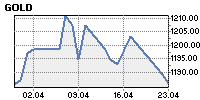
GOLD prices recovered by 14% over the first two months of this year after falling by 13% during the latter months of 2011. Since then, gold prices have drifted lower, falling by 9% to $1,620/ounces (oz). There are three principal factors that have driven the price of gold so far this year; central bank demand from developing countries, consumer demand from India and China and the prospect of further quantitative easing, particularly in the US. To date, while Indian demand has disappointed, demand from China and developing country central banks has helped to support gold prices. With the market still undecided regarding the prospects for further quantitative easing from the US Fed, this uncertainty has led to substantial volatility in gold prices.
After increasing by 4% to 2,800 tonnes in 2011, Natixis expects mined gold output to rise by 3% in 2012 to around 2,884 tonnes. Continuing the trend of recent years, the bank also expects secondary supply to remain strong, boosted by those western countries still struggling to emerge from the recent economic crisis.
Amid renewed concerns over both the European and US economies in recent weeks, the prospects for further quantitative easing cannot yet be ruled out. Furthermore, central banks are expected to remain buyers of gold at lower prices, helping to moderate gold price volatility. The bank has therefore moderated its central scenario slightly, envisaging an average price of $1,540/oz in 2012 followed by $1,210/oz in 2013.
SILVER. In a similar trajectory to gold, silver prices recovered by 24% during the first two months of the year but dropped by 20% between March and May. The bank’s analysts expect movements in the price of silver to mirror closely developments in the gold market, although a potential decline in prices could be exacerbated by recent weakness in industrial demand for silver, in particular the photo-voltaic sector.
PGM. During the first quarter of the year, platinum prices outperformed palladium, rising by 20.5% and reaching $1,650/oz, while palladium prices dropped by 4.5% to $635/oz. Platinum prices received a boost on the back of strikes and safety stoppages at mines in South Africa. Since the high in late-February, the price of platinum has fallen by 8% after work resumed at Implats’ Rustenburg mine.
The full version of the report is available in Documents section of Metals & Mining Newswebsite.


 After a weak fourth quarter in 2011, metal markets bounced in the first quarter of this year, boosted by the strength of US economic data, the success of the ECB’s long-term repo operations and optimism over a recovery in Chinese growth, Natixis said in a quarterly metals report. Heading into the second quarter, this optimism is beginning to wear thin.